
For most sellers, the appeal of auction lies in achieving an unconditional, legally binding sale the moment the hammer falls. So why do some auctioneers offer a conditional sale?
Looking to sell your home by auction? Before you sign the auctioneer's terms of business, you might find this article to be a useful read!
There are two key features that set an auction sale apart from an estate agency sale, they are:
1) Bidding - competitive bidding to achieve the best sale price.
2) Binding - a legally binding sale, where the buyer exchanges contracts on auction day and cannot back out of their purchase. This is known as an unconditional sale.
What is a "binding" sale?
When we say a sale is "binding", we mean legally binding. Under property law in England & Wales, this is the point at which contracts are exchanged and the buyer pays their deposit.
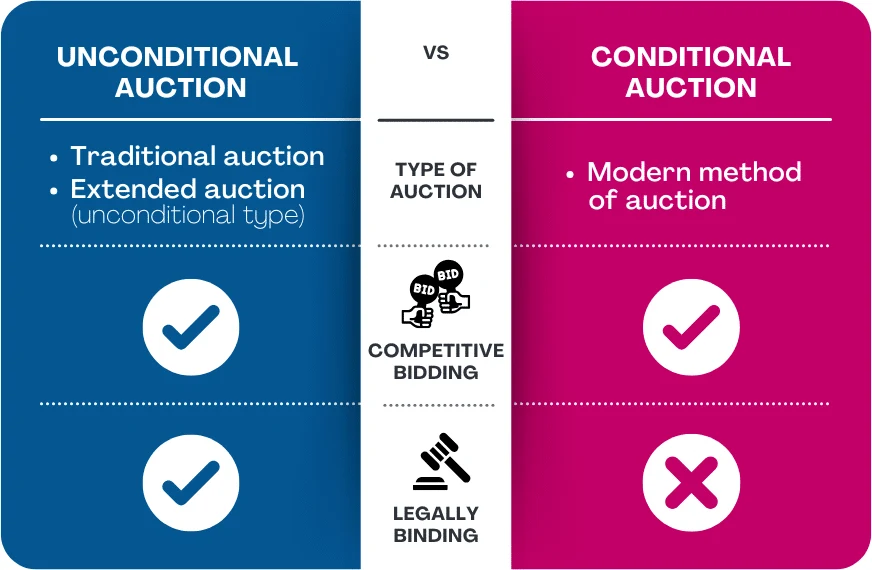
Unconditional auction sales are legally binding, while conditional auction sales are not. This article explains why some auctioneers offer a conditional sale, and why it's so important for home sellers to check exactly what type of auction sale they're signing up to.
Most traditional on-the-day auctioneers offer an unconditional sale as standard, turning to a conditional sale only in exceptional circumstances.
The modern method of auction is different - the term is effectively synonymous with a conditional sale.
Auction means auction. Or does it?
Has your estate agent recommended selling your property by auction? There's a good chance the type they've recommended is the modern method of auction - a conditional sale, which (unlike an on-the-day auction) does not become legally binding on the day.
We wanted to write this article because of the feedback we've had from sellers who found the auction they'd signed up to wasn't what they expected - often only realising later that their buyer was free to back out of the purchase.
Whilst conditional auction sales have their place, we believe it's important that sellers understand the rules are different from what "auction" is commonly understood to mean.
Signing up to the wrong auction type is one of the 10 mistakes to avoid when selling a house at auction, and it is often only discovered when a buyer walks away.
What's the issue with conditional auction?
Conditional auction sales are not legally binding. In fact, they're not all that different from accepting an offer through an estate agent; the offer is subject to contract, subject to legal enquiries, and subject to the buyer changing their mind.
Although not legally binding, there is some financial commitment from the buyer. The successful bidder at a modern method of auction (a conditional sale) does pay a reservation fee to secure the property. The reservation fee paid by the buyer gives them the exclusive right to proceed with the purchase (or not) for a period of 28 days (sometimes 56). During that period the buyer can carry out their survey and make legal enquiries before they exchange contracts. If the buyer does not exchange contracts, they lose their reservation fee. Whether the reservation fee is paid to the seller, or kept by the auctioneer, will vary from auctioneer to auctioneer.
This matters to you as the seller: if the fee is kept by the auctioneer rather than passed to you, a buyer pulling out can leave you with nothing but lost time.
Is there a longer auction that's still binding?
You might assume a longer bidding period only comes with the conditional rules of modern auction. It doesn't. There's a middle-ground option - one we find suits many sellers - that combines a longer marketing period with the security of a binding sale: the unconditional extended auction.
The rules of an unconditional extended auction are more like those of an on-the-day auction, where "sold" really does mean sold. The sale is not conditional upon survey or legal enquiries. The winning bidder's offer is unconditional; they legally exchange contracts and pay a non-refundable deposit. In short, the rules are the same as an on-the-day auction - the only difference is the longer bidding period.
You'll find all three auction types compared side by side in the table below.
Ready for a legally binding sale on auction day?
Unconditional auction sales are "exchange ready". That means both the buyer and the seller are in a position to exchange contracts on auction day.
Conditional auction sales have their uses, but for most people choosing to sell by auction, an unconditional sale is what they're really after.
| Feature | On-the-dayUnconditional | ExtendedUnconditional | Modern MethodConditional |
|---|---|---|---|
| Competitive bidding | |||
| Legally binding on auction day | |||
| Flexible auction date | |||
| Marketing period | 3 - 4 weeks | 1 - 2 months | 1 - 2 months |
| Bidding period | 2 - 5 minutes | 1 - 2 months | 1 - 2 months |
| Reserve price | Typically no more than 80% of market value | 90% of market value | 90% of market value |
| Upfront entry fee | £400+ | None | None |
| Cost (commission) | 2% - 3% | 3.5% - 5% | 3.5% - 5% |
| Who pays the costs | Seller | Buyer | Buyer |
| Best suited to | Unmodernised, run-down properties | Any type of property | Any type of property |
Notes relating to costs and dates stated in the above table:
Costs: Auction commission rates and upfront fees stated above are exclusive of VAT. Commission rates vary depending on geographic location and property value - auctioneers may reduce their fee for higher value properties.
Flexible auction date: On-the-day auction dates are fixed. Modern and extended auction dates can be changed; the auction end date can be brought forward or extended depending on the level of interest in a property.
Some exceptions where a conditional auction sale can be useful
As a general rule, we recommend selling by unconditional auction (either unconditional on-the-day auction or unconditional extended auction). But there are a few situations where a conditional sale can be useful:
- Where the sale depends on a management company approving the buyer. When selling a retirement flat or park home, for example, the management company may need to check the buyer meets certain criteria (such as age) before the purchase can go ahead.
- Where the sale depends on grant of probate. It's usually better to wait until probate is granted before offering a property for sale, but in some situations an auctioneer will market it sooner, with exchange of contracts conditional upon probate coming through.
- Where no buyer will commit to an unconditional sale. This can happen with high-value properties, where a buyer needs more time to arrange a mortgage. The auctioneer may ask whether you'll sell on a conditional basis to give the buyer time to sort out their finances. Crucially, the condition is usually tightly defined (e.g. conditional upon mortgage approval) rather than "conditional upon any reason" - so the buyer can't simply wriggle out because they've changed their mind.
Why sell by auction?
- Sell to the highest bidder
- Sales don't fall through
- Property "sold as seen"
Selling by auction makes a refreshing change, there are no protracted negotiations or sales falling through. With an unconditional auction sale the property is sold to the highest bidder and the sale is legally binding. There is no opportunity for the buyer to reduce their offer or back out of the sale.
Request a free reserve price estimate
Contact us for guidance on selling your home by auction. Request a free pre-auction appraisal - we'll be happy to help.
Other useful resources
- Guide to selling a house by auction - Explains the stages involved in an auction sale. With information about auction sale costs, timescales and the process for selling at auction.
- Carry out improvements before selling? - When selling a property in need of improvement, should I spend money on refurbishment works? Or leave the property as is, and let the new owner take care of improvements?
- Poor condition property: Auction VS Estate Agent - The private treaty method of sale isn't suited to some types of property - it's inefficient and potentially open to abuse.
- Selling a house in poor condition - The rules of an auction sale mean that buyers must compete to purchase a property. And the highest bidder's offer is legally binding - there is no opportunity for them to reduce their offer.